Hacker Phone — The Unifying Idea Behind Open Hardware

It's 2026. We live in the future. I have a computer in my pocket more powerful than the one that took up half of my desk twenty years ago, and there is almost nothing I can really do with it.
I moved through more phones than I can count. Now I ended up with a foldable. Bigger screen, stylus and a desktop mode promised versatility I could not find on my previous devices. It is by far the best phone I ever had, but I keep hitting the same problems. Mobile devices today do a lot of things well, but they do very few things great. As long as I want to read, watch or listen, everything is fine. The moment I want to do anything else, the experience quickly falls apart. The touch screen is horrible for anything except basic interaction. Simple things like writing a text are bad, editing is even worse. Playing a game? Forget it. Unless the game is designed around tapping a screen with one finger, you are better off staring out the window. No wonder there are no good games for mobile — there is no good way to play them. The best you can do to get a decent game is run an emulator and play games from systems that were actually designed for playing games. I know connecting a bluetooth controller is easy, I can even attach it to the phone, but I can't fit that in my pocket. The same goes for a keyboard, or any other accessory for that matter. If I want a handle, stand or a lens, there is no simple way to attach any of it to a phone. I have to buy a special case or I can use some spring loaded clamp. That's not a solution, that's a workaround and nobody seems to care, because that's how phones are. But do they have to be that way?
Values worth revisiting
I used to own a Nokia N900 before my first iPhone. It was one of the few true hacker phones — a device that let the user change everything. Reconfigure the system, load custom ROMs, overclock the CPU. I didn't fully appreciate it for what it was, but it was genuinely fun to own. The N900 was far from perfect, but seeing people still talk about it fifteen years later proves it was ahead of its time. However flawed the original device was, it represented values worth revisiting and expanding upon today.
Those values are not complicated. A device that doesn't tell you what it is. A device that becomes what you need it to be. A device that trusts the person holding it more than the company that made it. The industry moved in the opposite direction — toward thinner, closed, designed experience where the manufacturer decides everything and the user accepts it. We ended up with sports cars. Beautiful, powerful, and almost as impractical.
However that is not the only way to build a car. A van in stark contrast is a platform. It can be a workshop, a camper, a delivery truck, a stage. You decide what it becomes. It can be entirely utilitarian, entirely designed, or anywhere in between. The same physical object serves completely different people with completely different needs, because it was built to be shaped rather than accepted.
Platform not product
I want to make phones as flexible as a van. A device that is a platform rather than a finished product. Not for everyone — a sports car is a fine thing if a sports car is what you want. But for the people who have been asking more of their devices than their devices are willing to deliver, this is a different proposition. The person who wants a proper game controller attached to their device. The one who needs a handle and a real shutter button for photography. The security researcher who wants a penetration testing toolkit in their pocket. The maker who wants to build a custom module and sell it. The person who just wants physical buttons and the freedom to choose what goes on the back of their device. These people exist in large numbers. The industry has decided they are too complicated to serve. I disagree.
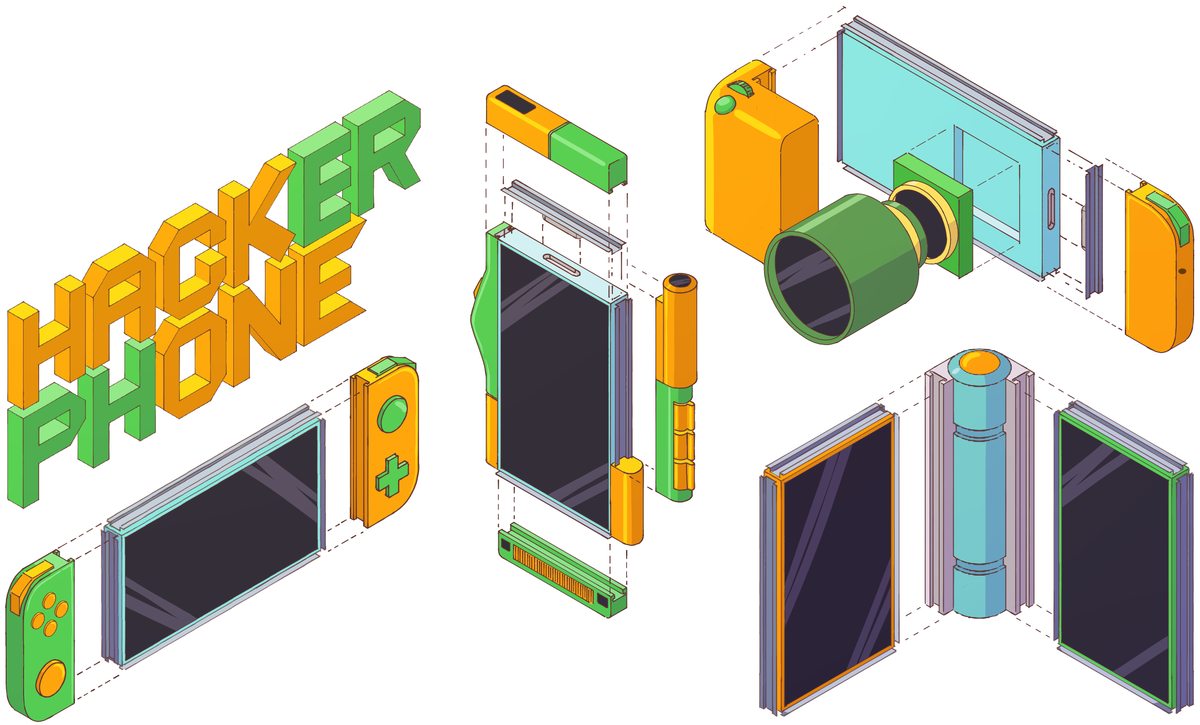
I want to make a device that is open on both the software and hardware sides, and on top of that, expandable. I don't mean inner component modularity. The device itself is whole — it has a CPU, battery, memory, display. It can be taken apart for repair, but its internal components are not the point. The point is what you attach to the outside. The phone should have a connector to attach accessory to and an interface to transfer data.
I imagine the connector in the form of a rail running around the entire device. The rail provides mounting points and a shared bus for whatever is attached — A game controller that clicks into place and charges from the device. A camera grip with a proper shutter button. An extra battery. An IR blaster. A card reader. A foldable keyboard. An FM radio — Whatever you can think of, and whatever the maker community builds, which will be more interesting than anything on that list.
The rail has to be well designed and set as an open standard with longevity in mind. The physical connector remains, the protocol layered on top evolves. The open standard guarantees that the platform cannot be enclosed. Anyone can make a module. Anyone can make a compatible device. The PCB makers, the 3D printing community, the bedroom engineers — they become part of the ecosystem the moment the standard is published. This is how Arduino shields happened. It is how the platform grows beyond what any single organization could sustain.
But the rail is only part of the idea. The bus it exposes does something more significant than connect accessories — it connects devices to one another. This changes the entire paradigm. You are no longer buying a phone, a tablet and a notebook separately. You are buying building blocks that transform into whatever form factor the situation demands.
Two phones connected become a dual-screen clam shell device. Connect a tablet and you get cellular from the phone, screen real estate from the tablet. Need a laptop? Connect a keyboard to the tablet. Two tablets become a dual-screen workstation. This is composable computing. It changes not just what the device can do, but what the device fundamentally is and the variations are almost infinite.
Each device is fully functional on its own. When combined, they share resources. The newest device contributes the most, older devices contribute whatever they can still offer — screen, battery, compute. You buy into a platform and let the form factor follow the use case.
We live in an era where we no longer own our media and we no longer own our software. Silently we no longer own our data and our hardware as well. The hacker phone represents a device philosophy where ownership is put back to user's hands, where it belongs.
Planned obsolescence becomes a choice, not a sentence. When a newer device joins your collection, the older one doesn't retire — it becomes a part of the whole. The device's role changes over its lifetime. That is sustainability in practice, not just in principle.
The Open Hardware Consortium
Fairphone, Pine64 and Purism are all building phones. Three companies united by the philosophy of freedom. All three of them are making the same device the big companies do, only less powerful, then competing with each other for the same small group of ideologically motivated buyers. They are selling philosophy in a market that runs on specs and price, and unsurprisingly, they are losing.
This is not a failure of values. It is a failure of strategy. They are fighting over a small patch of ground when there is an entire unexplored territory, free for taking, right next to them.
The capitalist framing calls them competitors. I disagree. Fairphone focuses on sustainability and ethical sourcing — the freedom of the people who build our devices. Pine64 focuses on affordability and community-driven development — the freedom to tinker and extend. Purism focuses on privacy and security — the freedom from being watched. These philosophies do not contradict each other. They complete each other. The underlying idea connecting all three is the same one at the heart of the GNU manifesto: that technology should connect people and empower them, not artificially divide them and extract from them. The GNU manifesto applied that principle to software. I want to apply it to hardware.
An Open Hardware Consortium would not ask these companies to abandon their identities. It would ask them to stop duplicating effort and start specializing. Instead of Fairphone making a phone and Pine64 making a different phone, both competing for the same customer, the Consortium makes a phone-sized module, a tablet-sized module, a keyboard module, a camera module. Each team builds what they are best at. Combined, they cover every form factor without redundancy. The ecosystem becomes something none of them could build alone.
Bulk component purchasing across the Consortium changes the economics significantly. The open hardware supply chain currently penalizes small players — manufacturers favor volume, and none of these companies have it alone. Together, they do. Lower component costs make ethical, open devices more accessible to more people, which is the stated goal of all three organizations. The incentive to cooperate is not just philosophical. It is practical.
Here is where the hacker phone changes the strategic picture entirely. The problem with the current open hardware landscape is not the values — it is that the product offers no functional advantage over mainstream devices. Philosophy alone does not move product when the device in your pocket already does everything the alternative does, only faster and with better software support. The hacker phone is different. It is not a better version of a mainstream phone. It is a different thing. A platform that can become a game console, a penetration testing device, a digital camera with interchangeable optics, a cosplay prop, a workstation. The expandable design embodies the freedom philosophy in a way that a standard device never could — freedom to repair, freedom to extend, freedom to connect devices together and change what they fundamentally are. The values stop being a selling point and start being the product.
During the design and production of the device aligning these philosophies will create tensions. The ideal is a device that can stand up to all of them. When compromises have to be made, a flawed device with a strong direction and philosophy behind it is better than nothing at all. The next iteration can be better and more aligned with the unified philosophy. The important thing is to start.
The market
The market for this exists and we can measure it. A small portable hacking toy — an open source device that reads RFID cards, emulates remotes, probes radio protocols and not much else. It sold over half a million units at two hundred dollars each, generating eighty million dollars in a single year, despite being banned from Amazon and having no mainstream marketing. Half a million people bought a single-purpose hacking gadget because it was open, expandable and built for curiosity rather than consumption. That is the floor. A fully functional phone that can become that hacking tool, plus a game console, plus a camera platform, plus whatever the user decides to make it — that is a considerably higher ceiling.
Software
Hardware without software is dead metal and silicon. Software developers need to be part of this movement from the start — not handed a finished hardware prototype and asked to make it work, but invited into the design process early enough to shape it. The software problems and the hardware problems are not sequential. They are the same problem viewed from a different angle.
The hacker phone needs an ecosystem, and that ecosystem has to be tailored to the device and its expanded capabilities. However building that ecosystem will take time. For this reason Android compatibility layer is essential. It is the bridge that keeps the device functional while the open ecosystem grows around it. It is a necessary compromise.
As composable computing changes the mobile device paradigm, making it more flexible, the software needs to adapt to the new capabilities. Device to device connection brings entirely new set of software challenges. Two phones attached by the rail suddenly behave like a small cluster. They need to share resources — ram, disk space, compute and apps. They need to negotiate which device is primary and which is secondary, which resource is worth contributing and which is not. Both screens need to behave as a single display. Files, apps and windows have to flow from one screen to another naturally as if on a single device. Android has not been built with this functionality in mind. No current mobile operating system has. This is new, unexplored territory. It is exactly the kind of challenge that deserves attention and open mind — A new compositor layer, a new inter-device protocol, possibly a new application model has to be built — However that does not make it a reason to abandon the idea. That makes it the reason to pursue it.
The same kind of challenge appears when composable computing turns the device from pocket to workstation. At some point the mobile interface stops being useful and a full desktop environment needs to take over. That transition should be seamless — the way a well-designed responsive layout of a web page reflows as the screen grows. Desktop mode on the hacker phone cannot be an afterthought bolted onto a mobile interface. It has to be a first-class paradigm that the OS was designed to support from the beginning. This not only brings a new point of view, blurring the line between desktop and mobile software. It also demands a new set of developer tools.
This is where mobile Linux distributions have the opportunity to shine and demonstrate what they can really do. The Android compatibility layer keeps the lights on. The Linux foundation is where the real work happens.
Hacker phone is a device we will never get from the big companies, they make devices for everyone, which means they make them for no one in particular. Hacker phone is a device for people who want more. It is a device that answers to and respects the person who owns it - open, expandable, repairable and yours. It is a platform that can be built upon, instead of a set device that has to be accepted. It is a device we won't get unless we design and build it ourselves. This manifesto is an invitation to collaborate for all the engineers, makers and tinkerers who find the idea of a hacker phone compelling.